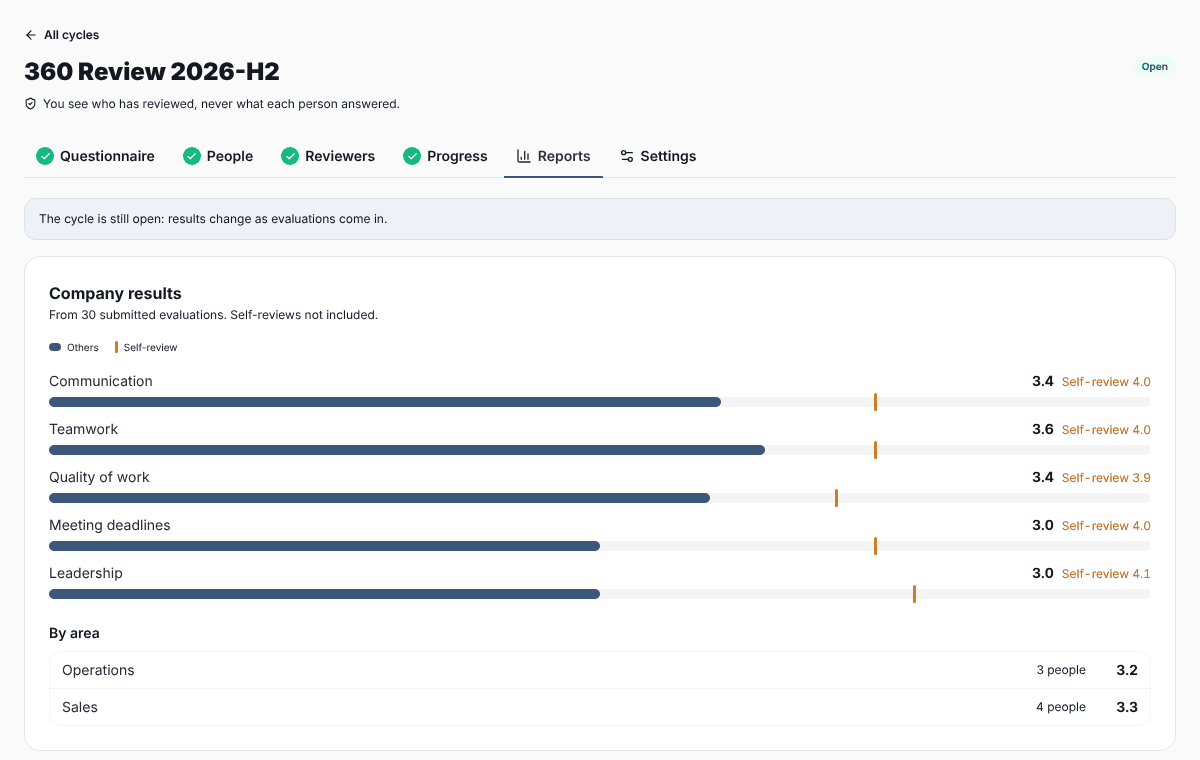
Competency framework: how to build a simple one to evaluate your team
Ask five people to rate a colleague's "teamwork" from 1 to 5 and you get five different ideas of what teamwork is. A competency framework fixes that: it describes, in concrete words, what is expected for each competency and what it looks like at different levels.
It does not need to be an 80-page document. For a small or mid-sized company, a two-page one works better because people actually read it.
1. Pick a few competencies
Between 5 and 8 in total. More than that tires reviewers and dilutes the message. A base that works for almost any company:
- Communication.
- Teamwork.
- Customer focus (internal or external).
- Organization and follow-through.
- Problem solving.
- Leadership, only for people who manage a team.
Add one or two specific to your business, the ones that explain why a customer chooses you. If the competencies have nothing to do with the strategy, the review becomes paperwork.
2. Define them with behaviors
A good definition can be observed. "Is proactive" cannot be seen; "suggests solutions before being asked" can. Write one line per competency describing what someone who has it does.
3. Write levels
Levels make a 3 mean the same thing to every reviewer. Four levels are usually enough, each with a behavior that sets it apart from the one before.
Communication
Conveys ideas clearly and listens before answering.
- Level 1Explains only when asked and is sometimes unclear.
- Level 2Explains their own work clearly.
- Level 3Adapts the message to the listener and checks understanding.
- Level 4Helps others communicate better and steers difficult conversations.
A practical way to write them: think of a real person at each level and describe what they do. Then remove the names.
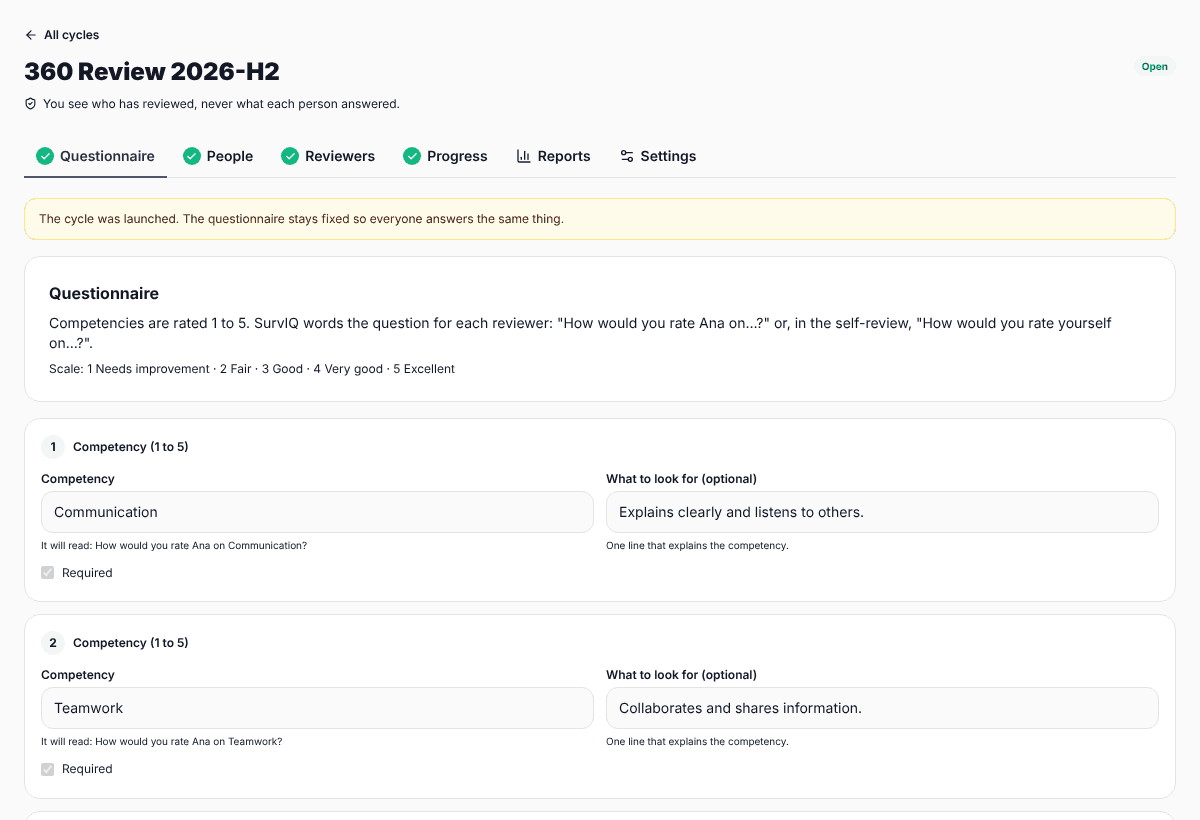
4. Turn it into questions
In the review form, each competency becomes a question with its behavior. That way the reviewer is not rating an abstract word but something they saw.
5. Review it after the first cycle
After the first review, look at which competencies almost everyone rated the same (they are not telling people apart) and which open comments keep coming up with no competency to capture them. Adjust, but do not change everything every year: if the competencies stay the same, you can compare cycles.