OKRs vs SMART goals: differences and when to use each
 By Enzo CaminoPsychologist and founder of SurvIQ
Every so often someone suggests “switching to OKRs”, and the discussion ends with a question nobody answers well: so what do we review people with? The confusion comes from thinking OKRs and SMART goals compete. They don’t: they answer different questions.
| SMART goals | OKRs | |
|---|---|---|
| What they are for | Measuring what each person achieved | Aligning the team on a few priorities |
| How ambitious | Realistic: meant to be met | Stretch: hitting 70% is already good |
| How often reviewed | Mid-year and at year end | Every quarter, with weekly check-ins |
| Affect the score | Yes, with their weight | Usually not |
| Who sets them | The person with their manager | Leadership and each team |
They don’t compete: many companies use OKRs for business direction and SMART goals to review each person.
SMART goals: what you commit to and get reviewed on
A SMART goal is specific, measurable, achievable, relevant and time-bound. It is agreed between the person and their manager, and it is meant to be met. That is why it is the backbone of reviews by objectives: at year end actual is compared with target, and that goes into the score with its weight.
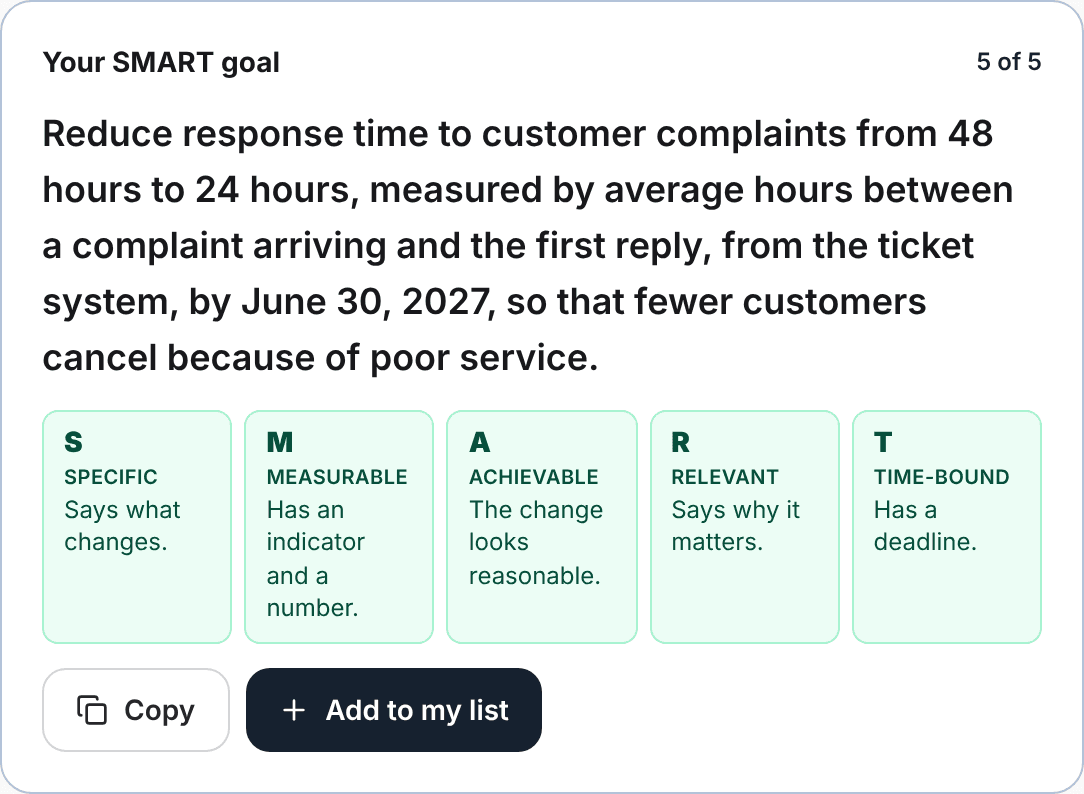
Example: “Reduce complaint response time from 48 to 24 hours by June 30, measured by the ticket system, so that fewer customers cancel.”
OKRs: what the team pursues
An OKR has a qualitative, inspiring objective and 2 to 4 measurable key results. It is set per quarter, usually for a team or the company, and it is meant to be ambitious: if you hit 100%, it was probably too easy. Reaching 70% is already considered a good result.
Example: Objective “Customers who don’t want to leave”. Key results: cut monthly churn from 4% to 2.5%; raise NPS from 32 to 45; answer 90% of complaints in under 24 hours.
The most common mistake: reviewing people on OKRs
If OKRs go into each person’s score, everyone will propose easy key results to look good, and you lose what makes them useful: aiming high without fear. That is why most companies using OKRs keep them out of the review, or use them only as context in the conversation.
How to use them together
- Leadership sets 3 to 5 company OKRs for the quarter or half-year.
- Each area turns the ones that concern it into its own OKRs.
- Each person, with their manager, writes 3 to 6 SMART goals that contribute to those OKRs. Those goals are what gets reviewed.
- The review conversation covers both: what the person achieved (SMART) and how they contributed to what the team was pursuing (OKRs).
Which one does your company need?
- If you are just starting performance reviews: SMART goals. They are simpler and connect straight to the score.
- If the problem is every area pulling in a different direction: company OKRs, even if reviews stay on SMART goals.
- If teams change priorities every few weeks: quarterly OKRs with short check-ins, and few individual goals.
To turn a vague goal into a SMART one, step by step:
Free SMART goal generatorGoals, self-review, manager review, 9-box calibration and sign-off, in a portal where each person signs in without an account.
See SurvIQ Performance Review