How to write measurable goals for performance reviews (with examples by area)
 By Enzo CaminoPsychologist and founder of SurvIQ
"Improve communication with customers." "Be more proactive." "Optimize processes." These goals show up in almost every review and share one problem: in December nobody can say whether they were met.
A measurable goal answers three questions: what will be measured, how much is expected and by when. With that, the review stops being an opinion.
From vague to measurable
- "Improve customer service" → "Cut complaint response time from 48 to 24 hours by December".
- "Sell more" → "Reach $500,000 in sales this year".
- "Reduce errors" → "Bring billing errors down from 30 to fewer than 10 a month".
- "Improve team morale" → "Raise the team’s eNPS from 10 to 25 in the October survey".
- "Roll out the new system" → "Have the inventory system running in all 4 stores before September".
The three goal types
Almost every goal fits one of three types, and each is calculated differently:
- Higher is better: sales, new customers, satisfaction. Achievement is actual divided by target.
- Lower is better: days to close, errors, turnover, cost. Achievement is target divided by actual.
- Yes or no: launch a project, earn a certification. It is either met or not.
| Goal | Target | Actual | Achievement |
|---|---|---|---|
| Yearly sales (higher is better) | $500,000 | $560,000 | 112% |
| Days to close the books (lower is better) | 5 days | 6 days | 83% |
| Launch the new portal (yes or no) | Yes | Yes | 100% |
Higher is better: actual ÷ target. Lower is better: target ÷ actual. With a cap (say 120%) so one goal cannot hide the others.
Cap achievement, for example at 120%. Without a cap, someone who tripled one goal can hide doing nothing on the others.
How many goals and how much each weighs
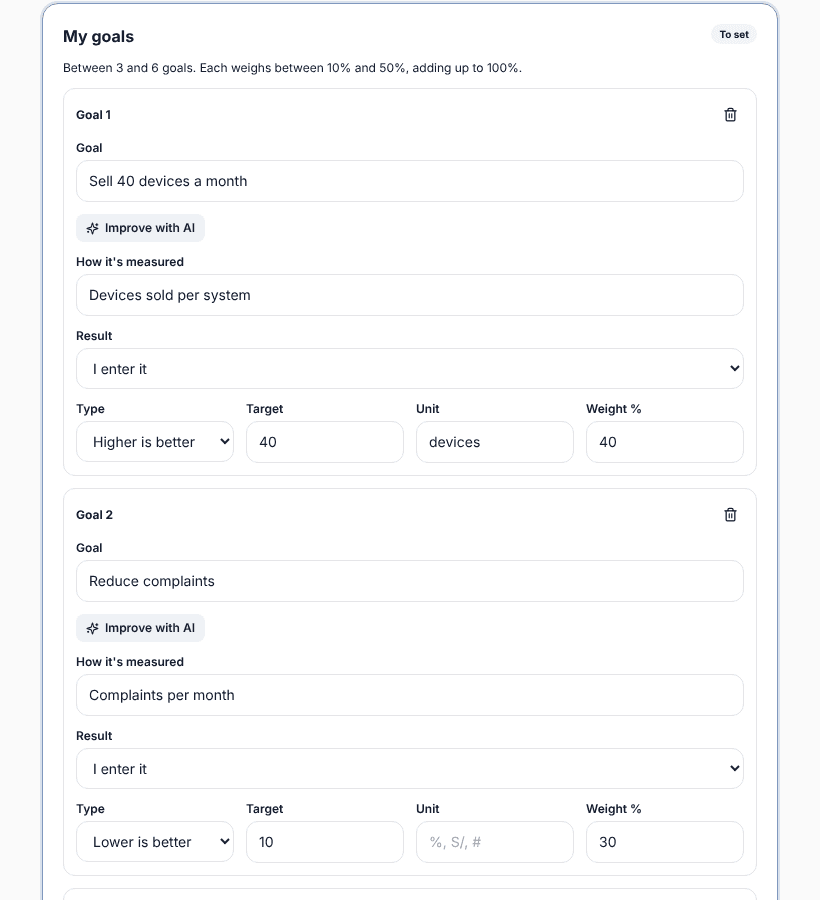
Between 3 and 6 goals per person. With fewer, one bad month decides the whole year; with more, nobody knows which one matters. Each goal has a weight and weights add up to 100%. The most important goal of the year should weigh at least 30%.
Examples by area
Sales
- Yearly sales: $500,000 (higher is better).
- New customers: 24 this year (higher is better).
- Overdue receivables: under 5% of the portfolio (lower is better).
Operations
- On-time deliveries: 95% (higher is better).
- Shrinkage: under 2% of inventory (lower is better).
- ISO 9001 certification earned before October (yes or no).
Human Resources
- Days to fill a vacancy: 30 or fewer (lower is better).
- First-year voluntary turnover: under 15% (lower is better).
- Performance review closed with 95% participation (higher is better).
Finance
- Monthly close in 5 business days (lower is better).
- Budget variance: under 5% (lower is better).
- New weekly cash flow report running before April (yes or no).
Customer service
- Satisfaction after each interaction: 4.5 out of 5 (higher is better).
- Complaints solved on first contact: 70% (higher is better).
- Response time: 24 hours or less (lower is better).
Goals that connect to the team’s
Individual goals make more sense when you can see which team goal they feed. If sales has to reach $3 million, each rep’s goals should add up to something close. Some companies also make the manager’s goal the average or sum of their team’s.
Common mistakes
- Goals that depend on things the person cannot influence at all.
- Copying last year’s goals without checking they still make sense.
- Task goals ("do the monthly report") instead of results ("report delivered by the 3rd of each month").
- Not reviewing them mid-year, when they can still be adjusted.
Step-by-step manual:
Goals: rules, approval, Excel and cascadingWrite your goals step by step and check them against the five SMART letters:
Free SMART goal generatorGoals, self-review, manager review, 9-box calibration and sign-off, in a portal where each person signs in without an account.
See SurvIQ Performance Review