9-box grid and calibration: how to use them in performance reviews
 By Enzo CaminoPsychologist and founder of SurvIQ
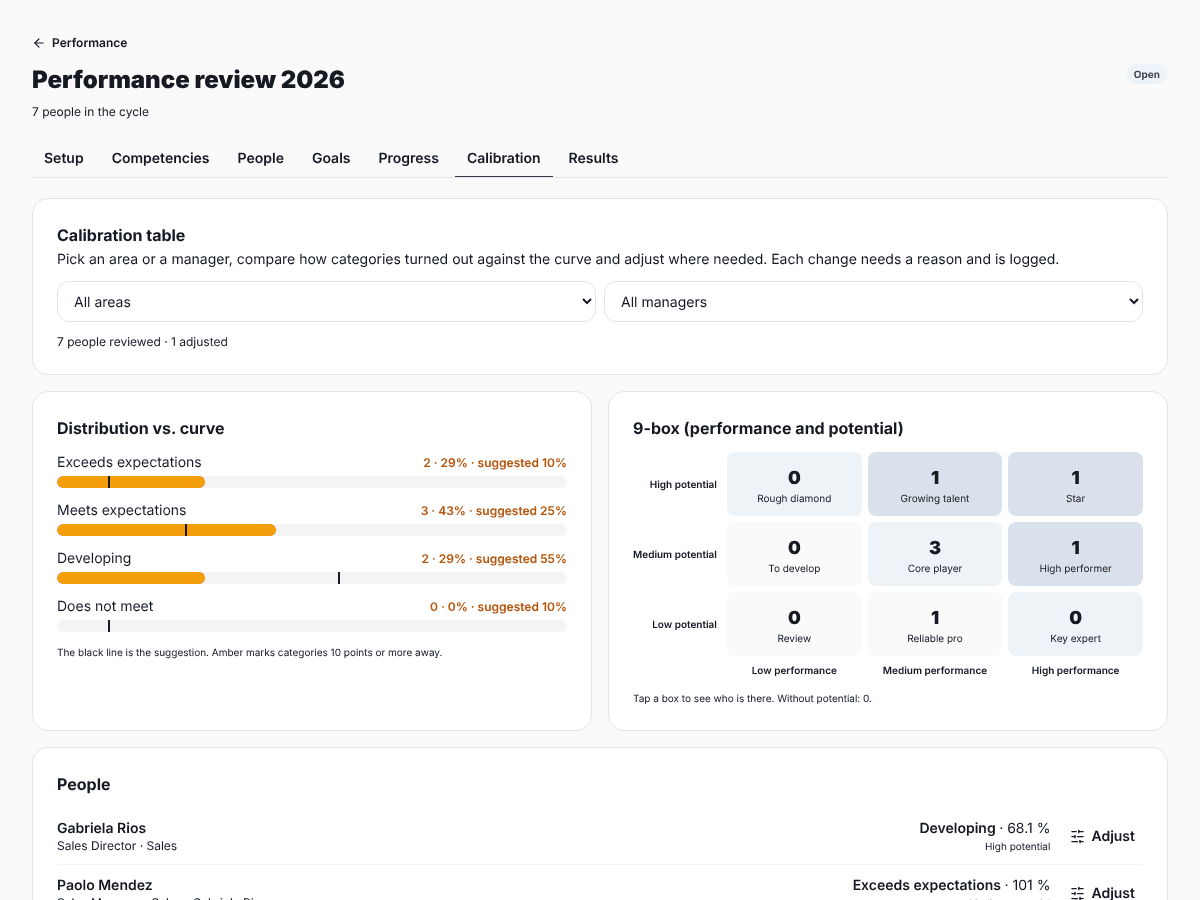
The 9-box grid places each person on two questions: how well did they do their job this year (performance) and how much can they grow in the coming years (potential). Each axis has three levels, which makes nine boxes.
Potential
Performance
How to read it
- Top right (high performance and high potential): the people to invest in first and the ones you cannot afford to lose.
- Center: most of the company. They do their job well and are the base of any team.
- Bottom right (high performance, low potential): trusted experts. Not everyone wants or needs to be a manager, and that is fine.
- Top left (low performance, high potential): often someone new in the role or in the wrong seat. They deserve a conversation before a label.
- Bottom left: they need a clear improvement plan, with dates and support.
Performance comes from the review. Potential does not: it is the manager’s and committee’s view of what the person could do. That is why it pays to define potential with 2 or 3 questions before using it.
What calibration is for
Each manager reviews with their own ruler. One is generous, another strict, another gives everyone a 3 to avoid trouble. Calibration is the meeting where HR and managers look at all scores together and make sure a 4 means the same in sales as in operations.
How to run the calibration meeting
- Before the meeting, every manager finishes their reviews. You do not calibrate half-done scores.
- Look at the overall distribution against a reference curve. If 70% "exceed expectations", something is inflated.
- Review by manager: who has their whole team at the top or at the bottom.
- Discuss the extremes and the borderline cases between two categories. You do not need to review everyone.
- Every change needs a written reason. If it cannot be explained, it does not change.
- Afterwards, the manager delivers the feedback, with the calibrated score.
Mistakes that ruin the 9-box
- Using the curve as a mandatory quota. It is a guide: if a team really is better, it can have more people at the top.
- Showing people their box without context. "You are in box 4" does not help; talking about what they need to grow does.
- Confusing potential with seniority or with being liked.
- Building the grid once and filing it. It helps when it is reviewed every year and tied to development plans.
Step-by-step manual:
Calibration and 9-box in SurvIQPaste your list with performance and potential and see your 9-box grid instantly:
Free 9-box gridGoals, self-review, manager review, 9-box calibration and sign-off, in a portal where each person signs in without an account.
See SurvIQ Performance Review