Performance appraisal methods: which one your company needs
 By Enzo CaminoPsychologist and founder of SurvIQ
When a company decides to review performance, the first temptation is to copy another company’s form, usually a large one. The trouble is that form was built for a different reality: other roles, another number of managers and another HR team to keep it running.
Before choosing a form, choose a method. These are the five most common and what each one measures:
| Method | What it measures | Fits |
|---|---|---|
| Simple rating scale | Competencies rated 1 to 5 | Companies reviewing for the first time |
| Management by objectives | Weighted goal achievement | Sales, operations, roles with clear numbers |
| Competency-based | How the person works | Support, admin, roles without numeric goals |
| Mixed (goals and competencies) | What they achieved and how | Most companies from 30 people up |
| 180° or 360° | Input from manager, team and peers | Managers and roles that work across areas |
You can combine them: for example, goals and competencies for everyone, and 360 only for people who lead teams.
Simple rating scale: to get started
The manager rates each person 1 to 5 on 4 to 6 competencies and writes a comment. It is quick, everyone understands it and it builds the habit of a yearly conversation. Its limit is that it depends heavily on the manager: two managers can give very different scores for the same work.
Management by objectives: when there are clear numbers
Each person has 3 to 6 measurable goals at the start of the year, each with a weight. At year end you compare actual against target and get an achievement percentage. It works very well in sales, operations, collections or production, where results can be counted. It is harder in support roles, where work does not always become a number.
The key is writing the goals well from the start. If in January they say “improve service”, there will be no way to measure them in December.
To write measurable goals:
Free SMART goal generatorCompetency-based: how the work gets done
It reviews behaviors: teamwork, communication, customer focus, leadership. It suits every role and is what helps most when planning each person’s development. To work, every number on the scale needs a sentence describing it; otherwise a “4” means something different to each manager.
Mixed: goals and competencies
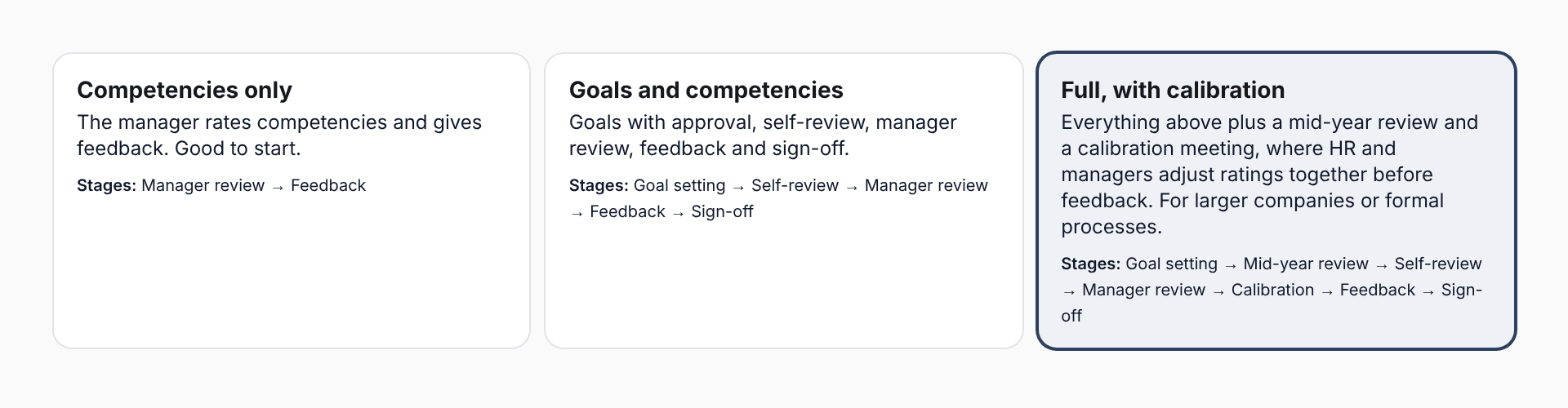
The most common in mid-sized companies: the final score combines goal achievement (what they achieved) with competencies (how they achieved it). A usual starting point is 60% goals and 40% competencies, adjusted by area. That way nobody scores high just for selling a lot while running over their team, or just for being helpful while missing their results.
180° or 360°: more perspectives
It adds input from the team, peers or internal customers to the manager’s. It is very useful for managers, because the people who best know how someone leads are their team. It takes more work: choosing reviewers, protecting anonymity and preparing the feedback well. That is why it pays to start only with people who lead teams.
How to choose
- Fewer than 20 people and first time: a simple scale, or goals and competencies with few questions. The conversation is what matters.
- 20 to 200 people: the mixed method. If you have sales areas, give goals more weight there.
- Several layers of managers: add 360 or upward feedback for people who lead, and a calibration meeting across managers.
- If managers have no time: fewer competencies and fewer stages. A simple process that gets finished beats a complete one abandoned in October.
Pick the simplest method that answers your main question. If you want to know who delivers results, objectives. If you want to know how to develop your people, competencies. If you want both, mixed.
To try the mixed method with one person before rolling it out to the whole team:
Free performance review template (Excel and Word)Goals, self-review, manager review, 9-box calibration and sign-off, in a portal where each person signs in without an account.
See SurvIQ Performance Review