How to measure whether people know a message inside an employee survey
 By Enzo CaminoPsychologist and founder of SurvIQ
"Are you informed about the company's benefits?" measures perception. Many people say yes even when they don't know what the benefits are. If what matters is whether a message landed, ask about the content of the message and have a correct answer.
How to write a knowledge question
- One correct answer, clear to whoever designed the campaign.
- Believable distractors: options someone who missed the message might pick.
- A "Don't know" option. It is better for someone to pick it than to guess: guessing inflates the % correct.
- Few questions: three to six are enough to see which messages landed. It isn't an exam.
Respondents don't need to know there is a correct answer. In SurvIQ they see no score unless you turn it on.
How to read the results
The main figure is the % correct of each question. Side by side, sorted from highest to lowest, it shows which messages are known and which aren't. Then the same figure by department answers the most useful question: where to reinforce.
- A question with few correct answers across the company points at the message or the channel.
- A question with few correct answers in one department points at how the information traveled there, often the direct manager.
- A high % of "Don't know" is better news than a high % of one wrong answer: the first is missing information, the second is wrong information going around.
A knowledge index
If each question is worth 100 when the person gets it right and 0 when not, the average of those questions is a 0 to 100 knowledge index per person. You can compare it by department like any other factor and cross it with favorability: do the departments that know the most also rate communication best?
How to do it in SurvIQ
- In the editor, turn on Exam mode on the question and mark the Correct option. You don't need a pass mark or a timer.
- In Results, each question shows the % correct.
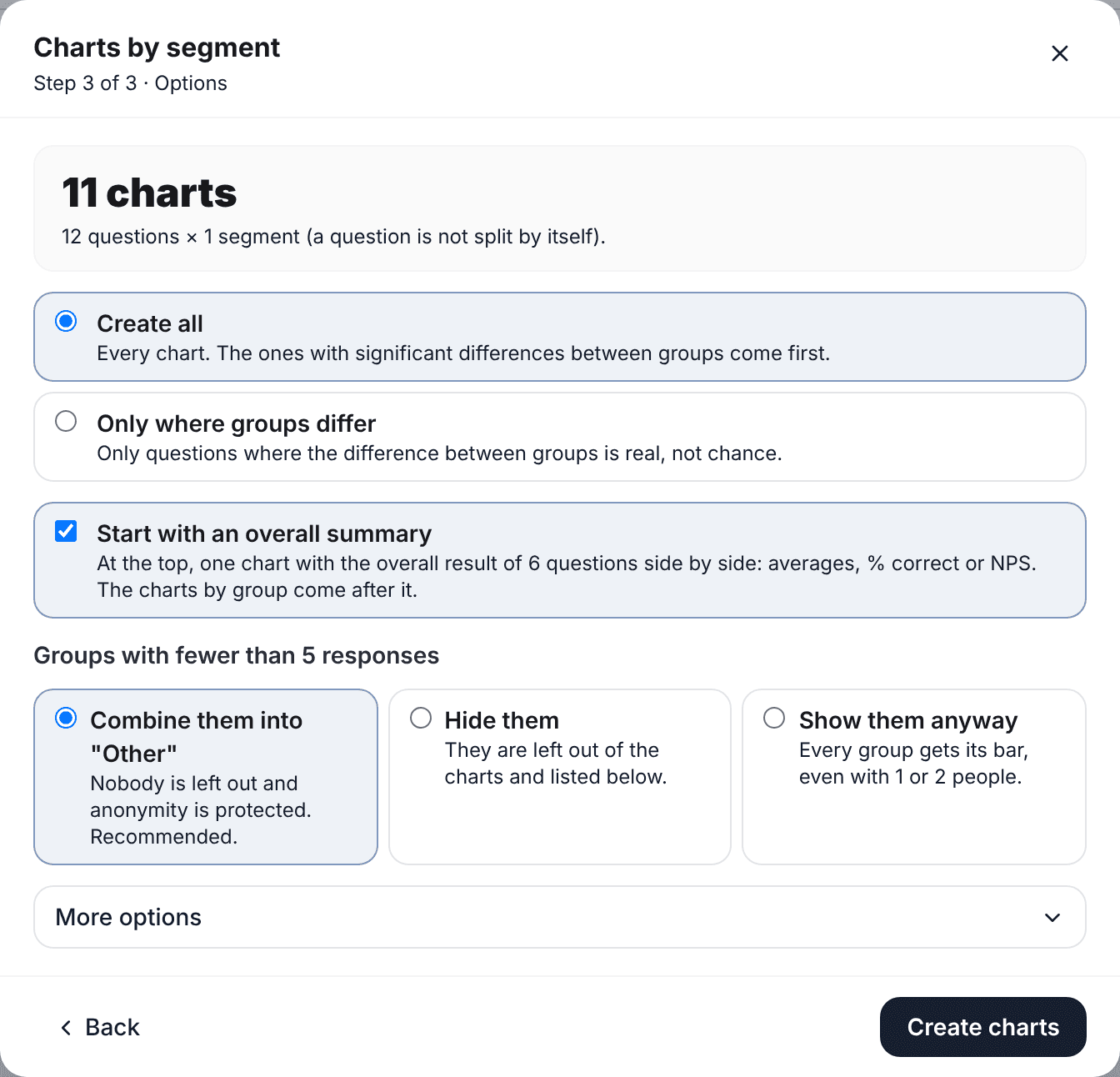
- In Charts by segment, these questions show as Correct / Incorrect by department.
- The Several questions summary puts the % correct of all of them side by side, and in a factor each question is worth 100 or 0.
The full tutorial:
Knowledge questions, step by step